Export email to CSV
Modified on Thu, 1 Oct at 4:58 PM
Keep a record of your incoming emails in a CSV file. Each time an email is processed, a new row is added with the email data you choose: sender, subject, date, and more.
A CSV file is plain text. You can open it in Excel, Access, or any text editor, and import it into most databases.
Tip: Want to know more about the format? See CSV on Wikipedia.
Add the action
- Create or edit a scenario.
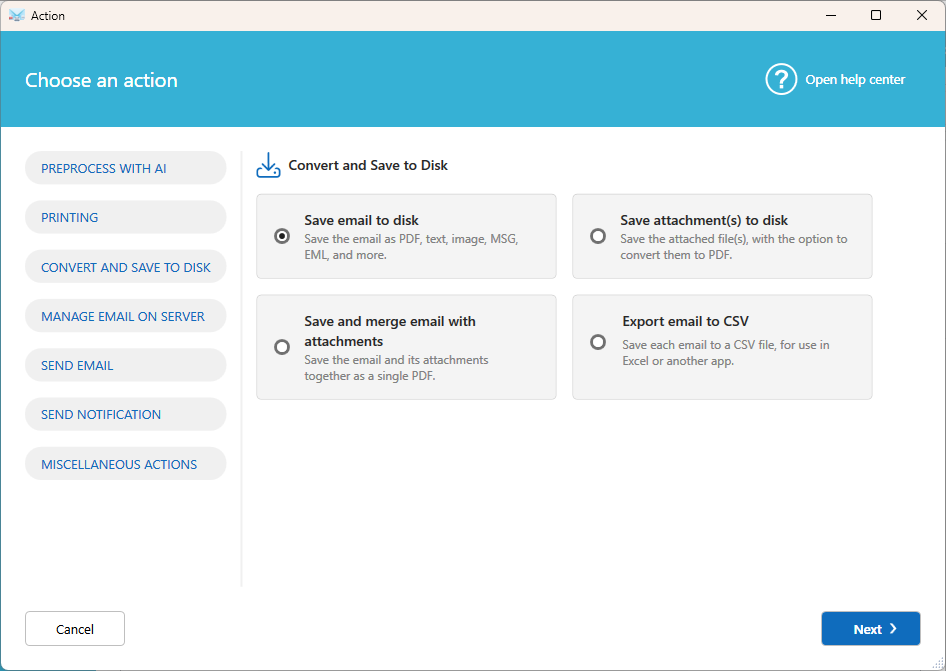
- Click Add action, then select Convert and save to disk, then Export email to CSV.
- Configure the export:
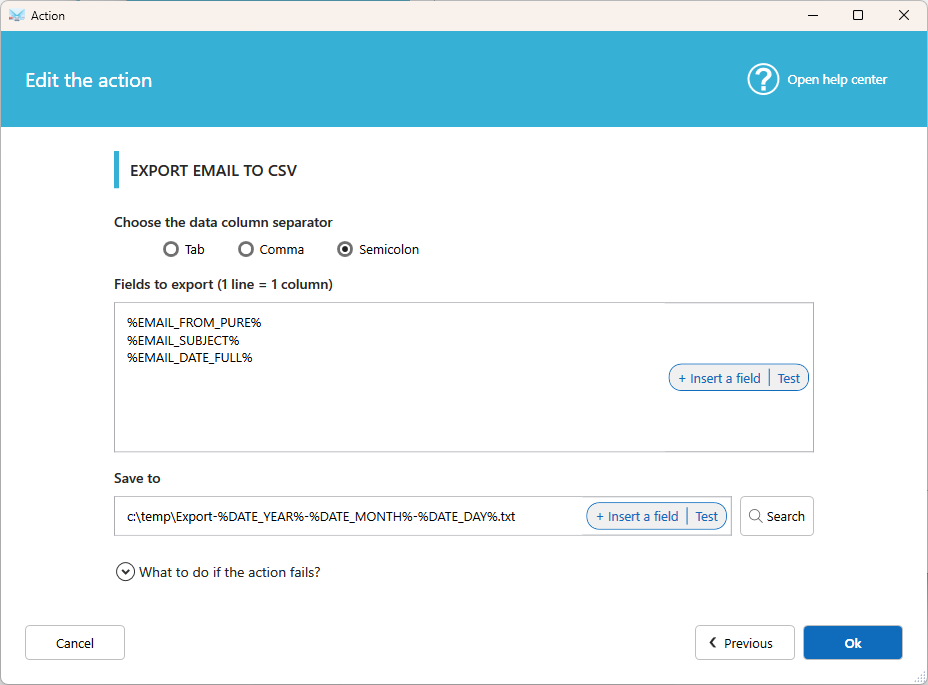
- Choose the data column separator: Comma by default. You can also select Tabulation or Semicolon.
- Choose the fields to export: Select the email data to include. Each line is one column in the file.
- Save to: Where the file is saved. Include fields in the path or file name to create a new file per day, month, or account.
- Click Ok to save the action.
Examples
- One file per month: use a date field in the file name, such as
emails-2026-10.csv. - One file per account: use the account name field in the file name.
Tips
- If you open the file in Excel and all the data appears in a single column, change the separator. In many European countries, Excel expects a semicolon.
- Use a condition in your scenario to export only the emails you need, such as orders or invoices.
Related articles
- Use fields functions to extract part of your data
Was this article helpful?
That’s Great!
Thank you for your feedback
Sorry! We couldn't be helpful
Thank you for your feedback
Feedback sent
We appreciate your effort and will try to fix the article